
Solar panel cost UK: what you'll actually pay in 2026
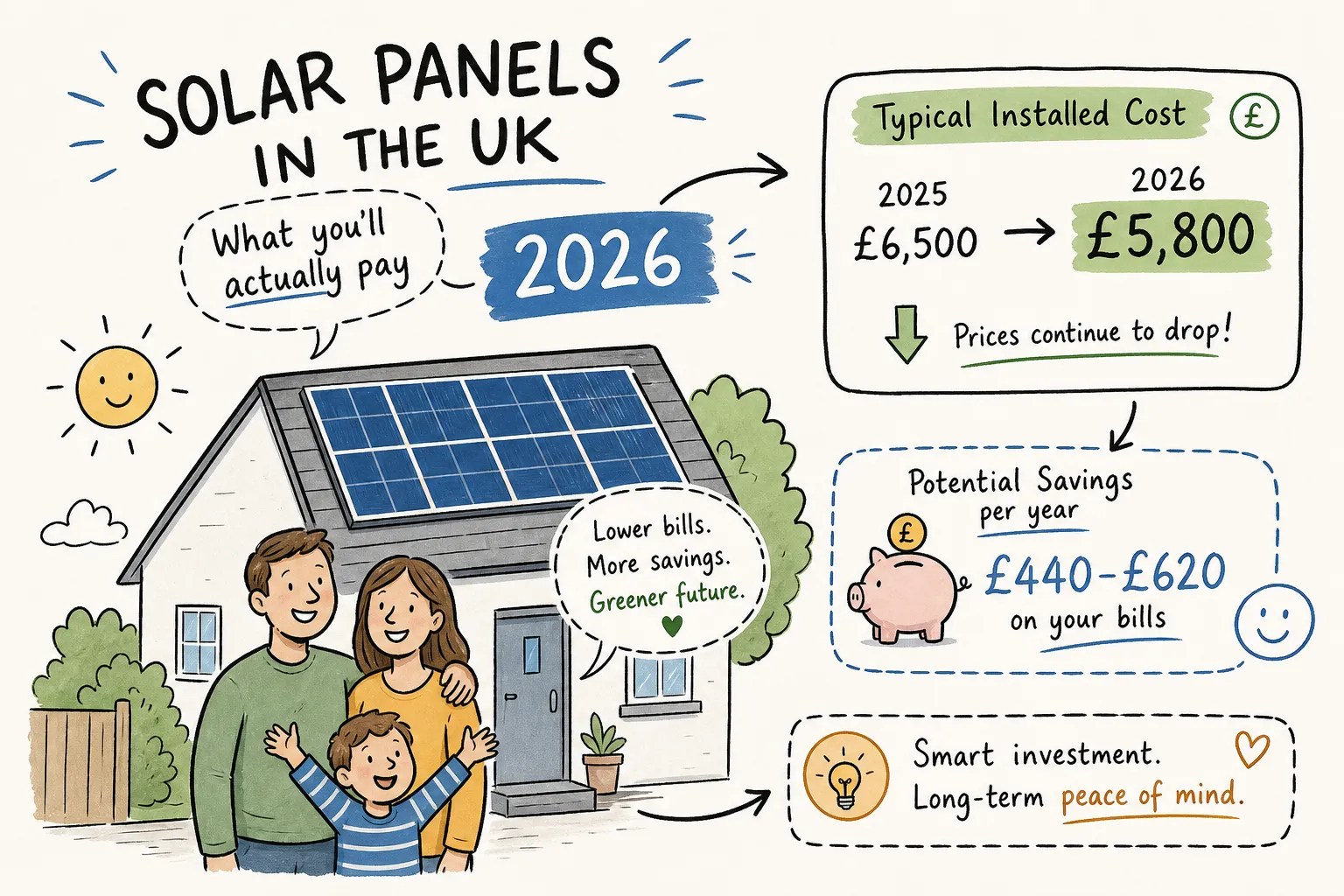
Search "solar panel cost UK" right now and you'll find quotes ranging from £5,500 to £20,000 with almost no explanation for why. One website says a 4kWp system costs £5,500. Another quotes the same size at £9,000. Neither tells you what's included, what drives the difference, or whether either figure is reasonable for your home. That gap isn't accidental. It reflects genuine variation in equipment quality and regional labour costs, as well as what installers choose to bundle into their prices.
Here you'll find real price ranges for 2026, a clear breakdown of what drives cost differences, honest payback expectations, and the finance options worth knowing about. Services like Go Solar UK exist to connect you with local, MCS-certified installers, at no cost to you, so the quotes you receive reflect actual market rates. But before you speak to anyone, it helps to understand the numbers yourself.
Solar panel cost UK: what a solar installation actually costs in 2026
The most useful anchor for any solar quote is the cost per kilowatt-peak (kWp) of installed capacity. In 2026, the average installed cost for a straightforward domestic solar PV system sits between £1,500 and £2,200 per kWp, with most standard home installations landing in the £1,600 to £2,000 range. This figure covers panels, inverter, mounting hardware, labour, and MCS certification. Residential solar installations currently attract 0% VAT under HMRC's energy-saving materials relief, confirmed through to March 2027, so the price you see is the price you pay.
Larger systems cost less per kWp because fixed costs such as scaffolding, system design, and inverter setup are spread across more installed capacity. A 6kWp system on a straightforward roof will almost always be cheaper per kWp than a 3kWp system on the same property.
System size to price: from a small terrace to a larger family home
These are realistic all-in price ranges for the four most common domestic system sizes in 2026, including hardware, labour, scaffolding, and MCS certification:
- 3kWp system: £5,000 to £6,500 (suited to a smaller home or low energy usage)
- 4kWp system: £6,000 to £8,000 (the most common size for a UK semi-detached or mid-terrace)
- 5kWp system: £7,500 to £9,500 (appropriate for a larger family home with higher consumption)
- 6kWp system: £9,000 to £15,000 (suited to detached homes with good south-facing roof space)
A 4kWp system is a common starting point for many UK homes. It generates enough to cover a meaningful share of annual household consumption and fits comfortably on a typical semi-detached roof without requiring a full south-facing aspect.
Why do solar panel prices vary so much: Two quotes for the same system can differ by £3,000
A £3,000 gap between two quotes for a 4kWp system doesn't automatically mean one installer is overcharging. The difference usually comes down to panel brand and efficiency tier, inverter type (a hybrid inverter costs more than a standard string inverter but makes battery addition far simpler later), and whether scaffolding, DNO registration, and commissioning are bundled in or itemised separately. The cheaper quote isn't always the better one. Ask every installer to confirm exactly what their price includes before comparing figures.
Solar panel cost UK, adding a battery: what it really costs and whether it's worth it
Battery storage is the single biggest variable in a solar quote, and it deserves an honest assessment rather than a sales pitch. Adding a battery changes both your upfront cost and the way your system behaves day to day, particularly in the evenings and during winter months when solar generation drops off.
What home battery storage costs in 2026
A 4 to 5kWh battery, suited to smaller households or those who want to cover evening usage without full energy independence, adds roughly £3,000 to £4,500 to the installed cost. A 10kWh battery for a larger home or higher energy usage adds closer to £5,000 to £8,000. If your solar system uses a standard string inverter rather than a hybrid inverter, retrofitting a battery later will also require an inverter upgrade, which adds further cost. Specifying a hybrid inverter from the outset costs more upfront but avoids that expense down the line.
For a broader look at typical battery and storage pricing and how it affects returns, see this solar panel and battery storage cost guide.
How a battery changes your payback calculation
A battery extends your payback period in most cases because it adds significant upfront cost. A well-sized 4kWp solar-only system typically breaks even in 6 to 8 years. The same system with a 10kWh battery sits closer to 9 to 12 years. The battery earns its place by increasing your self-consumption rate, reducing what you import from the grid overnight, and becoming considerably more valuable when paired with a time-of-use tariff that charges cheaper overnight electricity. For households with high evening usage or those pursuing greater energy independence, the financial case is stronger than payback figures alone suggest.
If you're planning to expand an existing array or integrate batteries after installation, this practical guide on adding solar panels to an existing system explains compatibility and design considerations to watch for.
The extras that quietly push your final quote higher
Most solar price guides show clean system costs. The real final bill sometimes includes line items that homeowners didn't anticipate. Knowing these in advance means you can ask the right questions before signing anything rather than querying an invoice afterwards.
What a well-structured quote should include
A thorough quote from a reputable installer will cover: solar panels, inverter, mounting system, DC and AC cabling, system commissioning, MCS certification, and DNO (Distribution Network Operator) notification. Scaffolding is sometimes itemised separately. On a standard two-storey home, scaffolding typically adds around £300 to £700 depending on roof height and access, though this can be higher for difficult or complex roofs. If a quote appears unusually low, confirming whether scaffolding is included is a sensible first question.
The add-ons that can move the price significantly
Three extras come up regularly and are worth understanding before you receive quotes:
- Microinverters or power optimisers: For roofs with partial shading, a dormer window, or a complex multi-pitch layout, microinverters or optimisers improve system performance significantly. Expect to add £1,200 to £1,500 over a standard string inverter setup for leading brands such as Enphase or SolarEdge.
- Roof repairs or reinforcement: Minor repairs before installation are realistic on older properties and can add £200 to £1,000 depending on the work required. An installer who flags this proactively is a good sign; one who doesn't mention it is a yellow flag.
- Export meter upgrade or DNO application: This is usually free to around £150. Confirm with your installer before signing, because occasionally a formal DNO application is required for larger systems and carries a fee.
What you'll realistically save and when you'll break even
Costs matter, but the return side of the equation is what makes the investment decision. At current 2026 electricity unit rates of around 24.5p per kWh, the savings picture for UK solar is genuinely compelling for the right home.
Payback timelines for different household types
A 4kWp system on a south-facing roof, used by a household that's home during the day and self-consumes a reasonable share of output, will typically break even in 6 to 8 years. A household that's largely out during daylight hours with no battery to store midday generation could see 8 to 10 years. The two primary savings drivers are avoided import cost, the electricity you generate and use directly, at around 24.5p per kWh at current rates, and Smart Export Guarantee (SEG) income on surplus exported to the grid.
SEG tariffs vary between providers and are subject to eligibility criteria, so it's worth comparing rates at the point of installation. As a guide, Good Energy currently offers around 25p per kWh, with OVO and EDF at approximately 20p and 18p respectively.
Lifetime savings estimates using 2026 electricity prices
Based on current unit rates and modest projected increases, a well-sized domestic solar system can save between £11,000 and £25,000 over a 25-year lifespan. Larger systems and homes with batteries that maximise self-consumption sit toward the top of that range. Solar isn't simply a bill-cutting exercise, it's a long-term financial asset on a property you likely plan to keep for decades, and one that many energy analysts expect to become more valuable as electricity prices remain elevated.
For a detailed breakdown of typical installation prices and components, see this independent solar panel costs guide.
Paying for solar without a lump sum: your finance options
Not every household has £6,000 to £10,000 available upfront, and that shouldn't be a barrier. Several realistic options exist for spreading the cost without undermining the investment case.
Solar loans and 0% finance deals
Many MCS-certified installers offer 0% or low-interest finance for 12 to 36 months. Some third-party green finance products extend to 5 to 10 years at fixed rates. On a 4kWp system financed over five years, the monthly repayment can be lower than the monthly bill savings the system generates, meaning solar is net positive from day one for some households. Wales has the Green Homes Wales scheme offering interest-free loans up to £25,000; Scotland offers the Home Energy Scotland Grant and Loan for qualifying homeowners. England's Warm Homes Plan is expected to introduce 0% lending for solar, though full rollout is expected to extend into 2027.
To explore contemporary borrowing options and what they typically cover, read this practical overview of solar finance options in the UK.
What to watch for in a finance agreement
Before signing any finance deal, check whether the loan is secured on your home, whether early repayment fees apply, and whether the system price has been inflated to offset the 0% offer. Some installers quietly adjust their quoted price when finance is introduced. Getting multiple quotes is the most effective protection against this, because you'll quickly spot if one installer's "finance price" doesn't match their "cash price."
How to get accurate solar panel quotes UK, without the sales pressure
Going directly to a single installer leaves you with no benchmark. You have no way of knowing whether £7,500 is fair for your system or whether the same job would be £5,800 two postcodes away. Getting multiple quotes is the single most effective way to protect yourself, but most homeowners find the process exhausting. The typical experience involves cold calls, repeated follow-ups, and quotes for different system specifications that are genuinely difficult to compare.
Why getting three or more quotes changes everything
Price differences of 20 to 30% for comparable systems are commonly reported across UK solar installers. A second or third quote doesn't just reveal whether the first price was fair, it also shows whether the first installer's system design actually suits your roof layout, energy profile, and usage patterns. A quote for a 4kWp system when your home warrants 5kWp will quietly cost you more over the system's lifetime than the apparent saving at the point of purchase.
How Go Solar UK removes the guesswork for free
Go Solar UK is a free, no-obligation comparison service that matches homeowners with up to four local, MCS-certified installers. Before any quotes are requested, the service produces a bespoke system design tailored to your home's roof orientation, energy needs, and usage profile, meaning every quote you receive is for the same system, making comparison straightforward rather than confusing. There are no cold calls or pressure to proceed, and the service is entirely free. It is funded by installers who value quality-matched leads, so the homeowner pays nothing.
Is solar worth it in 2026? The honest answer
For the right home, solar in 2026 is a sound investment. A payback period of 6 to 9 years on a system warranted to last 25 years, combined with lifetime savings of £11,000 to £25,000 and electricity prices that many analysts broadly expect to remain elevated, makes a strong financial case. What UK homeowners actually pay for solar panels varies considerably based on system size, battery choice, roof type, and installer, which is exactly why the average solar panel cost UK figures you read online are only a starting point, and why comparative quotes from vetted professionals matter far more.
For practical tips on maximising your system's performance and separating fact from fiction, see our Smart Energy guide.
If you're ready to find out what solar would realistically cost for your specific home, Go Solar UK can arrange free, no-obligation quotes from MCS-certified local installers. No commitment, no pressure, no fee. Get your bespoke quotes today.