
Comparing solar quotes in the UK: what really matters
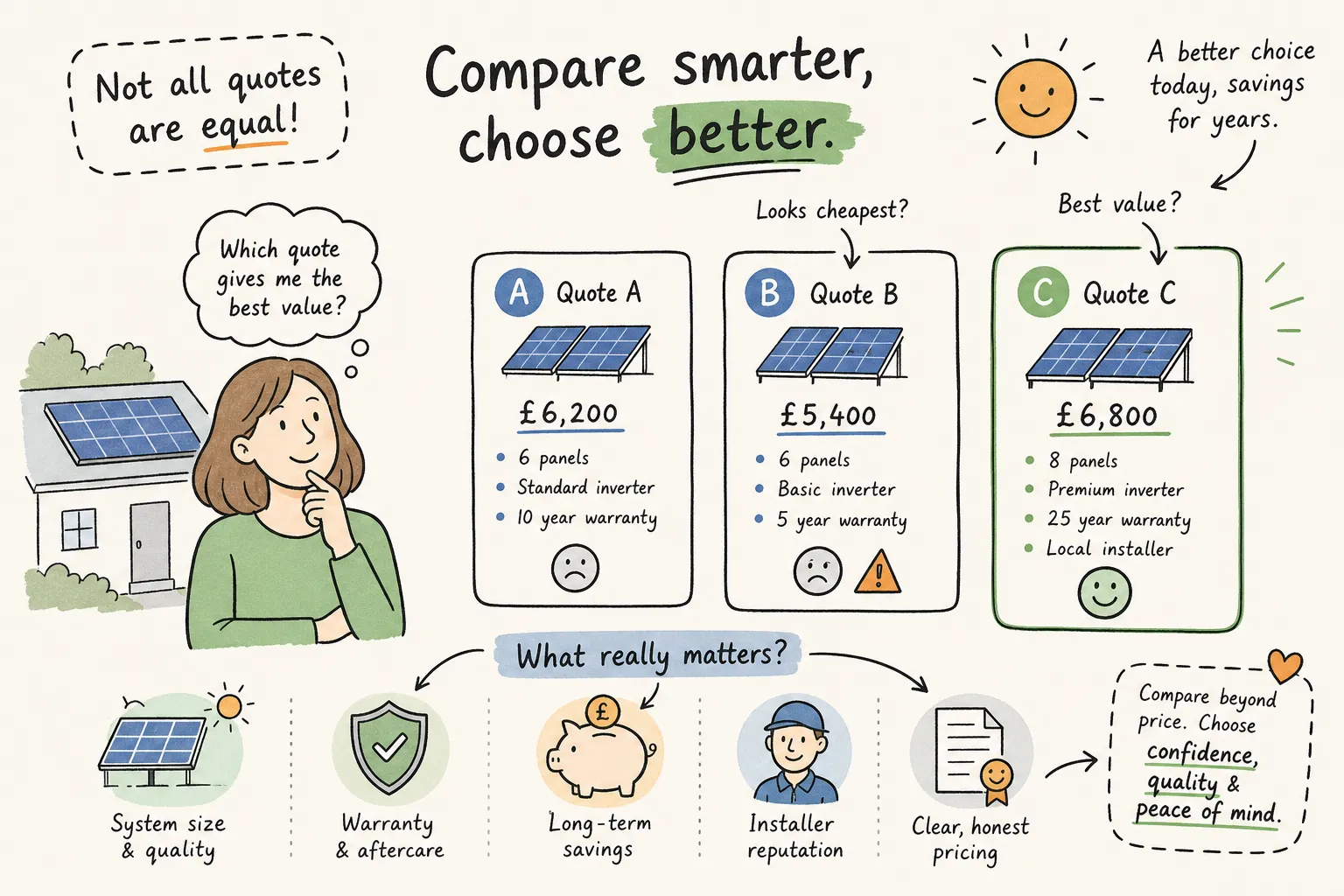
When it comes to a solar quotes comparison in the UK, most homeowners face the same immediate problem: the quotes arrive looking completely different from one another. One gives you a single lump-sum price. Another lists twelve line items with unfamiliar part numbers. A third leads with a monthly savings figure before you can work out what you're actually buying. None of them looks obviously wrong, but you can't compare them properly because they're not structured the same way.
This is where many homeowners get stuck. Whether you use a comparison service or go it alone, this guide walks you through exactly what to look for, what to ignore, and what to treat as a warning sign. We'll cover how to itemise quotes, normalise prices, check warranties, factor in batteries, verify installer credentials, and spot red flags before they cost you money.
1. What a solar quote should always itemise
A credible quote is not a single number. It should break down what you're buying into clear line items so you can see exactly where the money goes. If a quote arrives as a lump sum with no breakdown, that's already a problem worth addressing before you go any further.
Equipment: the items every quote must list
The equipment section should name specific products, not describe them generically. You need the panel brand, model, number of panels, and wattage per panel so you can calculate the total system output in kWp yourself rather than taking the installer's word for it. The inverter entry should state the brand, model, type (string, hybrid, or microinverter), AC output rating, and warranty length. Mounting hardware, roof fixings, and any bird-protection mesh should also be named specifically. If any of these appear as a vague category rather than a named product, ask for clarification before proceeding.
Installation costs and what's often left out
The installation section should cover DC and AC cabling, isolators, a generation meter, and monitoring setup. Scaffolding is a particularly common omission: the quote should state whether it's included, for how many storeys, and for how long. MCS certification paperwork, DNO notification, and the handover documentation pack are all part of a compliant installation and should appear in the quote. VAT treatment must be stated explicitly. Qualifying domestic solar installations in the UK currently attract 0% VAT (a rate in force until at least 31 March 2027, so it's worth confirming the position remains unchanged at the time you accept a quote), so any quote that doesn't clarify this is missing critical information. If any of these items are absent, ask before you accept.
2. Solar quotes comparison UK: how to normalise and benchmark prices
Once you have two or more itemised quotes, the next step is normalising them so you're comparing equal systems. A 4kWp quote from one installer looks cheap until you realise it uses 350W panels while a competitor's 4kWp quote uses 400W panels and a better-specified inverter, the same total kWp output can therefore require a different number of panels depending on wattage per panel. The panel count alone tells you very little.
Using cost per kWp as the equaliser
Divide the total installed price by the system's output in kWp. This gives you a single comparable figure regardless of how each installer has configured the system. A system with fewer but higher-wattage panels may represent better value per kWp even when the panel count looks lower. It's also worth knowing that larger systems cost less per kWp because scaffolding, labour, and inverter costs don't scale linearly with panel size, so a 6kWp quote at £1,600 per kWp is broadly comparable to a 4kWp quote at the same figure.
What to expect from 2026 UK price ranges
Use these 2026 benchmarks to sanity-check any quote you receive. These are VAT-inclusive, fully installed figures covering panels, inverter, mounting, electrical works, scaffolding, and labour combined, but they exclude optional battery storage:
- 2kWp: approximately £4,500, £5,500 fully installed
- 4kWp: approximately £6,500, £9,000 fully installed
- 6kWp: approximately £9,500, £16,000 fully installed
A quote significantly below the lower end should prompt you to ask what has been omitted. A quote significantly above the upper end should be justified by the installer with a clear reason, such as a complex roof, premium equipment, or multi-storey scaffolding. If no justification is offered, that's a red flag. For a bespoke, customised price based on your property usage and needs, complete the quotation form for an instant quote.
3. Understanding warranties: what those guarantees really cover
Three different warranty types appear in solar quotes and they protect entirely different things. Confusing them is easy, and it matters when something eventually goes wrong.
The three warranty types and what they protect
Product warranty covers manufacturing defects in panels and inverters. Standard manufacturer product warranties typically run for 1, 2 years, though a number of established brands offer extended product cover of 10, 12 years or longer, sometimes as a paid upgrade. Check the exact terms rather than assuming a headline figure applies in full.
Performance warranty guarantees that panels will produce a minimum percentage of their rated output over time, typically 80, 92% after 25 years, depending on the manufacturer. This is about long-term yield rather than manufacturing faults, and it's the warranty most likely to be quoted prominently in sales literature.
Workmanship warranty covers defects caused by poor installation rather than a faulty product. Workmanship warranties commonly range from 2 years up to 10 years or more; ask for the exact terms in writing and confirm whether the cover is insurance-backed. All three warranty types should appear in a proper quote pack. If only one is mentioned, ask where the others are.
Common exclusions buried in the small print
The exclusions homeowners most often miss include wear and tear over time, accidental damage unless explicitly covered, pre-existing roof conditions, cosmetic damage, and claims by anyone other than the original buyer. The two most practical checks are whether the warranty covers repair only or also includes replacement, and whether it requires the installer to still be trading to honour it. Insurance-backed guarantees address the latter risk by providing cover even if the installer ceases trading, which is a meaningful protection over a 10, 25 year time horizon. For guidance on best practice and consumer protections in extended warranties see the ABI good practice guide for extended warranties for consumers.
4. Factoring in battery storage when comparing quotes
Many homeowners receive quotes with and without a battery. The challenge is that battery quotes vary enormously depending on capacity, chemistry, brand, and how much margin the installer has applied. Without a consistent framework, comparing them is as difficult as comparing the original panel quotes.
What a battery quote should show you
A proper battery entry in a quote should state the brand, model, total nameplate capacity in kWh, and usable capacity, which is always lower than the nameplate figure. It should also specify whether the battery is DC-coupled or AC-coupled, confirm inverter compatibility, and clarify whether the battery carries its own dedicated warranty. In the UK in 2026, a typical 5kWh battery adds around £3,000, £4,000 to the total installed cost, and a 10kWh battery typically adds £4,000, £6,000. These figures include the battery unit, inverter gateway, and installation.
How to compare batteries on equal terms
The fairest comparison method is price per usable kWh, not price per nameplate kWh. Two 10kWh batteries can have very different usable capacities depending on their depth-of-discharge settings, so you're not always comparing the same product. Also compare round-trip efficiency: quality systems achieve around 90% or above, meaning less energy is lost in the charge-discharge cycle. A battery with a 10-year warranty and high round-trip efficiency generally offers better long-term value than a cheaper unit with shorter cover, even if the upfront cost is higher.
5. Installer credentials and red flags to watch for
Getting the price comparison right means nothing if the installer can't be trusted to do the job properly. Credentials are not optional extras in the UK solar market; they determine whether you have legal recourse if something goes wrong.
The credentials that actually matter
MCS certification is the key quality mark for solar PV in the UK. It is worth noting that MCS certification is technology-specific: some installers hold approval for heat pumps but not PV, or vice versa, so you need to verify the exact technology the installer is certified for, not just that they hold some form of MCS accreditation. Check the official MCS installer directory using the company name or their MCS contractor number, and confirm the listing matches. For practical advice on how to verify an installer's MCS status see a concise guide on how to verify if an installer is MCS certified. Membership of a Consumer Code such as RECC or HIES provides access to alternative dispute resolution if a dispute arises. TrustMark registration is relevant where government-backed schemes are involved. Insurance-backed guarantees add further protection if an installer ceases trading before their warranty period ends. If you want a step-by-step approach to selecting and assessing local trades, our 7 Steps to Find a Local Solar Installer, Go Solar UK article is a useful companion to this checklist.
Warning signs that a quote isn't trustworthy
Treat the following as serious concerns when reviewing any solar quote:
- No MCS number provided, or unwillingness to give one
- A lump-sum quote with no itemised breakdown
- VAT treatment absent or unclear
- Workmanship warranty missing or not confirmed in writing
- Scaffolding or DNO paperwork listed as an extra after the quoted price
- Pressure to sign quickly or a deposit required before a survey has been completed
Any single one of these issues warrants a direct question to the installer. Two or more together are a clear signal to walk away, ideally towards another MCS-certified installer who is willing to put everything in writing upfront. If you prefer to see vetted local options, our curated list of Best Local Solar Installers, Go Solar UK highlights installers who routinely provide fully itemised, compliant quotes.
6. Solar quotes comparison UK: letting a comparison service do the work
Normalising quotes, checking MCS credentials, verifying warranty terms, comparing battery options, and benchmarking prices against the market takes real time. Many homeowners approaching this for the first time are doing it once, without the benefit of having seen dozens of quotes. An independent intermediary changes that dynamic considerably.
How an independent comparison service works
Rather than contacting installers directly and triggering follow-up calls from multiple companies, a comparison service like Go Solar UK handles the process on your behalf. The service designs a bespoke system specification based on your roof orientation, energy usage, and household needs, then presents that specification to a curated panel of local MCS-certified installers. Because every installer is quoting the same specification, the quotes arrive in a consistent, comparable format. You're not trying to reconcile twelve different line-item structures across four different documents.
What you receive and why it costs nothing
Go Solar UK delivers up to four tailored quotes from vetted, MCS-certified local installers, with no obligation to proceed. The service is free to homeowners because installers cover the cost through reduced direct marketing spend, a model common to comparison services operating across the UK energy sector. That means you get structured system design, organised quote comparison, and verified installer credentials without paying for any of it, and without a salesperson chasing you for a decision. For homeowners who want the clarity of a proper solar quotes comparison in the UK without spending hours doing it manually, it is a practical and straightforward starting point.
Putting it all together
Start by checking that any quote is properly itemised, with named equipment, clear installation line items, and explicit VAT treatment. Normalise using cost per kWp and cross-reference against the 2026 benchmark price ranges. Review all three warranty types, product, performance, and workmanship, and check the small print for exclusions. If batteries are included, compare on usable capacity and round-trip efficiency rather than nameplate figures. Verify MCS credentials through the official directory and confirm the specific technology approval before accepting anything.
These steps protect you from overpaying, from accepting unsuitable systems, and from installers who look competitive on price but cut corners on compliance. A thorough solar quotes comparison in the UK doesn't need to be complicated, with the right framework, a few hours of diligent checking separates a good installation from an expensive mistake. The cost of getting it wrong is measured in thousands of pounds and years of substandard performance, so the time is well spent.
If you'd rather hand the process to someone with experience, get your free quotes through Go Solar UK. You'll see exactly what a properly structured, like-for-like comparison looks like, with no obligation and no sales pressure at any stage. For broader reading on smart energy topics, environmental considerations and common myths see our Smart Energy, Environment, Myths, and Conclusion, Go Solar UK guide.